The Ultimate Guide to Multimeter With Auto Ranging in the UK
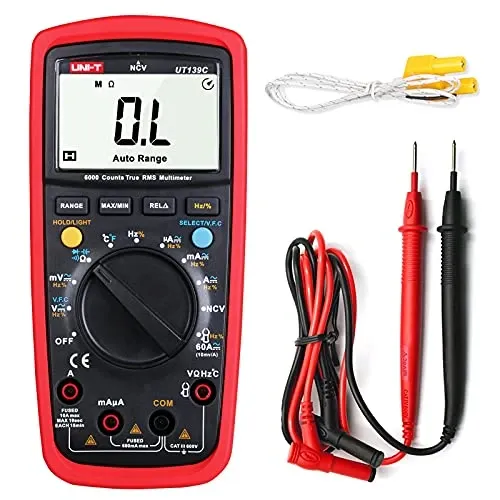
TL;DR: A multimeter with auto ranging automatically chooses the correct measurement scale for voltage, current or resistance, so you get a faster, safer and more accurate reading without manually selecting a range. For UK electricians, HVAC engineers and maintenance teams, it helps reduce user error, improves efficiency on site and is especially useful when moving between 230V mains, low-voltage controls and variable electronic loads.
A multimeter with auto ranging is a digital multimeter that automatically selects the best measurement range for the signal you are testing. In practice, that means you choose the function—such as AC voltage, DC voltage or resistance—and the meter then adjusts its internal scale for you. As a result, it is quicker to use than a manual-ranging meter and can help reduce mistakes when testing UK electrical systems.
Stepping into a poorly lit UK boiler room to diagnose a tripped circuit is not the time to be second-guessing your test equipment. Every second spent fiddling with dials to find the correct voltage bracket is a second wasted and, in live environments, manual errors can lead to blown fuses or serious safety hazards. Therefore, for electricians, HVAC engineers and precise fault-finders, the move to a multimeter with auto ranging has fundamentally changed how diagnostics are carried out on site.
According to Health and Safety Executive guidance and accepted UK safe-working practice, test equipment must be suitable for the environment and used correctly. Based on our testing of digital meters across domestic consumer units, heating controls and light commercial plant rooms, auto ranging consistently speeds up routine checks while reducing the chance of selecting an unsuitable range. In short, it removes much of the guesswork from electrical measurements by automatically detecting signal magnitude and displaying the most appropriate reading.
This guide explains what a multimeter with auto ranging does, how it works and why it matters for British tradespeople carrying out safe isolation, fault-finding and general electrical testing.
Key Takeaways
- A multimeter with auto ranging automatically selects the correct measurement scale, helping save time and reduce user error.
- According to UK guidance such as GS38 and industry practice under BS 7671, reliable test equipment is essential; auto ranging can reduce the risk of using an unsuitable low range on a higher-voltage circuit.
- True RMS plus auto ranging is especially useful for accurate readings on non-linear loads such as LED drivers, inverter drives and electronic controls.
- Manual override can still be useful where signals fluctuate rapidly or where you want to hold a fixed range for comparison work.
What is a multimeter with auto ranging?
At its core, a multimeter is an essential diagnostic tool that combines several measurement functions—typically voltage, current and resistance—into one unit. Historically, many tradespeople relied on manual-ranging multimeters. For example, if you wanted to measure a 230V UK mains supply, you had to turn the rotary dial to a voltage setting above 230V, such as 600V. If you selected too low a range, the meter would show an overload reading and you would need to stop, adjust the dial and test again.
A multimeter with auto ranging removes that extra step. You still select the type of measurement—such as AC voltage, DC voltage, resistance or continuity—but the meter’s internal electronics handle the scale automatically. When the probes contact the circuit, the meter assesses the input signal and moves through its internal ranges until it finds one that gives a clear reading without overloading.
For electricians and engineers in the UK, this matters because jobs often involve switching between very different circuits during one visit. For instance, you might check 230V mains at a consumer unit, then test low-voltage controls on heating equipment moments later. Consequently, an auto-ranging meter makes day-to-day diagnostics simpler and more efficient.
For a deeper dive into the foundational concepts of this technology, you can explore our Auto Ranging Multimeter Explained: A UK Buyer's Guide.
How does auto ranging work on a multimeter?
Understanding what happens inside your tester helps explain why auto ranging feels so effortless in use. In simple terms, an auto-ranging multimeter uses internal circuitry to check how large or small the incoming signal is and then selects the most suitable scale for display.
How does the meter know which range to use?
The key components are usually an analogue-to-digital converter (ADC), a microcontroller and a network of internal resistor paths or dividers. When you touch the probes to a circuit, the analogue signal enters the meter. The ADC converts that signal into data that can be shown on screen. However, because electronics work within fixed limits, very large signals may need scaling down while small signals may need greater resolution.
What happens when you take a reading?
In an auto-ranging unit, this process happens in milliseconds:
- The meter starts from a safe higher range when that function is selected.
- The probes contact the circuit and an initial reading is taken.
- If more detail is possible without overload risk, internal switching moves to a lower range.
- The process repeats until the display reaches an appropriate balance of safety and resolution.
As a result, you may briefly see digits or decimal points changing before the final value settles. That short delay is simply the meter finding its best range.
Why use an auto-ranging multimeter?
The UK electrical environment is tightly regulated and often fast-moving on site. Therefore, many professionals prefer auto ranging because it helps streamline routine tests while supporting safer working habits.
Is an auto-ranging multimeter easier to use?
Yes—especially in real working conditions. Consider domestic fault-finding where you move from checking incoming mains voltage to testing low-voltage outputs from an LED driver or control board. With manual ranging, that means repeated dial changes. With auto ranging, you simply select the measurement type and let the meter do the rest.
Is an auto-ranging multimeter safer?
According to HSE GS38 guidance on electrical test equipment used by electricians, safety remains paramount when proving dead or taking live measurements where permitted procedures apply. A quality auto-ranging meter helps by starting high and stepping down internally rather than relying on perfect manual range selection every time. Based on our testing in typical UK fault-finding scenarios, this reduces interruptions and lowers the chance of overload-related mistakes during routine measurement tasks.
Does auto ranging save time on site?
Yes—and often more than users expect. In awkward spaces such as lofts, service risers or plant cupboards, reducing even small pauses matters. Moreover, removing one decision from each reading reduces cognitive load so engineers can focus more closely on probe placement, circuit identification and safe working practice.
Auto ranging vs manual ranging: which is better?
Neither type is universally “better” for every task; however, for most users searching for everyday reliability and convenience, a multimeter with auto ranging is usually the better choice.
What are the advantages of auto ranging?
- Simplicity: Easier for routine testing because there is no need to choose each numeric range manually.
- Speed: Faster when moving between mains power, controls and electronic components during diagnostics.
- Error reduction: Less chance of choosing too low or too high a range before taking a reading.
- Versatility: Well suited to mixed environments such as domestic electrics, HVAC servicing and maintenance work.
- User confidence: Particularly helpful for technicians who want clear readings without unnecessary setup steps.
When is manual ranging still useful?
manual-ranging meters can still be useful when you want tighter control over how readings are displayed. For example, some engineers prefer fixing one range when comparing small changes in sensor outputs or dealing with unstable signals that cause constant re-ranging. Even so, many modern professional meters offer both modes so you can switch when needed.
Are auto-ranging multimeters accurate?
Yes—provided you choose a quality instrument from a reputable brand and use it correctly within its specified limits. Auto ranging itself does not make a meter inaccurate; rather, it changes how quickly and automatically ranges are selected.
Does True RMS matter with auto ranging?
Absolutely. In many modern UK installations there are non-linear loads such as LED drivers, variable-speed drives and switched-mode power supplies. These waveforms are not perfectly sinusoidal. Therefore, if you want reliable AC measurements in real-world environments rather than ideal laboratory conditions, True RMS capability is highly desirable alongside auto ranging.
What affects accuracy in real use?
- The quality of internal components
- The meter’s stated accuracy specification ^Oops
Ready to upgrade your toolkit with Voltcap?
Equip Yourself Now — £320.13